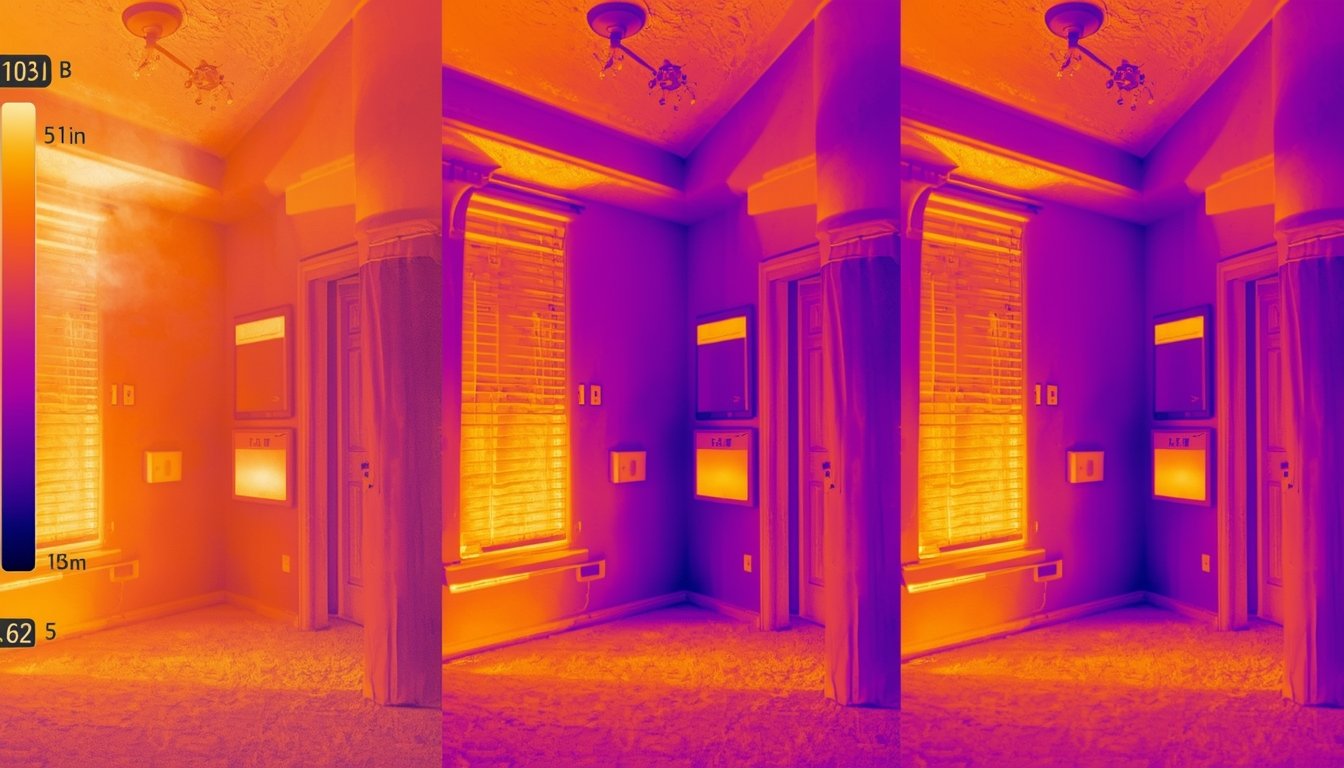
A thermal camera and a moisture meter are used for different but complementary purposes. A thermal camera helps you locate areas where moisture may be present by showing temperature differences, while a moisture meter confirms whether materials are actually wet and how much moisture is present.
How thermal cameras and moisture meters work differently
A thermal camera works by detecting temperature differences across surfaces. When materials become damp, they often change how they absorb and release heat, which creates visible patterns in a thermal image. This allows you to identify areas that may be affected by moisture without opening walls or causing damage.
A moisture meter, on the other hand, measures the actual moisture content within a material. Depending on the type of meter, it may use pins that penetrate the surface or sensors that scan just below it. This provides a direct reading that confirms whether moisture is present.
The key difference is that a thermal camera is a locating tool, while a moisture meter is a confirming tool. One shows where to investigate, and the other tells you what is actually happening.
This distinction is important because temperature differences can be caused by several factors, not just moisture. To understand how thermal patterns form, it helps to review how a thermal camera works before relying on those readings.
Using both tools together provides a much clearer and more reliable assessment than using either one alone.
When to use a thermal camera
- When you suspect a hidden leak but cannot see visible damage
- When trying to locate moisture spread across walls or ceilings
- When scanning large areas quickly to find irregular patterns
- When identifying problem areas before opening surfaces
- When checking for temperature-related issues alongside moisture
A thermal camera is most useful at the early stage of an inspection. It allows you to scan entire rooms, walls, or ceilings and identify areas where something is different.
For example, if you suspect a leak but cannot see any staining, a thermal scan may reveal a cooler patch where moisture is affecting the surface. This gives you a clear starting point for further investigation.
It is also useful for understanding how far moisture has spread. A leak may originate in one location but affect a larger area, and thermal imaging can help map that out quickly.
However, it is important to remember that thermal cameras do not confirm moisture. They highlight temperature differences that may indicate a problem, but further testing is always needed.
When to use a moisture meter
- When you need to confirm if a material is actually wet
- When measuring the level of moisture in walls, floors, or ceilings
- When tracking how moisture levels change over time
- When verifying repairs or drying progress
- When distinguishing between moisture and other causes of temperature change
A moisture meter is used after you have identified a potential problem area. It provides direct confirmation, which is essential for making decisions about repairs.
For example, if a thermal camera shows a cool patch on a wall, a moisture meter can confirm whether that area is damp or simply affected by airflow or insulation differences.
It is also useful for monitoring changes. If you are drying out a leak or repairing damage, a moisture meter allows you to track progress and ensure that the issue has been fully resolved.
Unlike thermal imaging, which shows patterns, a moisture meter gives you measurable data. This makes it a critical tool for confirming and documenting moisture-related issues.
Why using both tools together gives the best results
Using a thermal camera and a moisture meter together provides a more complete and reliable inspection process. Each tool compensates for the limitations of the other.
A thermal camera allows you to quickly scan large areas and identify where something might be wrong. This reduces the need to test every surface manually and helps you focus on specific locations.
Once you have identified a suspicious area, a moisture meter allows you to confirm whether moisture is actually present. This step prevents misdiagnosis and ensures that you are addressing the correct issue.
For example, a cool patch on a ceiling could indicate a leak, but it could also be caused by airflow or insulation gaps. Without confirmation, it is easy to make the wrong assumption. The moisture meter provides the clarity needed to move forward with confidence.
This combination of tools is particularly useful in complex situations where multiple factors may be affecting temperature and moisture. By using both, you can reduce uncertainty and make more accurate decisions.
Common mistakes when choosing between the two
One common mistake is relying on a thermal camera alone to confirm moisture. While it can highlight potential problem areas, it cannot provide definitive proof. This often leads to incorrect conclusions.
Another mistake is using a moisture meter without first identifying where to test. Without guidance, you may miss the affected area entirely or spend unnecessary time testing multiple locations.
It is also important to consider conditions. Thermal cameras require temperature contrast to work effectively, while moisture meters require proper contact with the material. Using either tool incorrectly can reduce accuracy.
Understanding the strengths and limitations of each tool helps you use them more effectively and avoid these common issues.
How to decide which tool to use in your situation
Choosing between a thermal camera and a moisture meter depends on what you are trying to achieve.
If your goal is to locate a potential problem, a thermal camera is the better starting point. It allows you to scan large areas and identify where temperature differences exist.
If your goal is to confirm a problem, a moisture meter is essential. It provides the data needed to verify whether moisture is present and how severe the issue may be.
In many cases, the best approach is to use both tools in sequence. Start with a thermal scan to identify suspicious areas, then use a moisture meter to confirm your findings.
This approach combines speed with accuracy, allowing you to diagnose issues more effectively and avoid unnecessary work.
By understanding when and how to use each tool, you can make better decisions and improve the overall quality of your home inspection process.