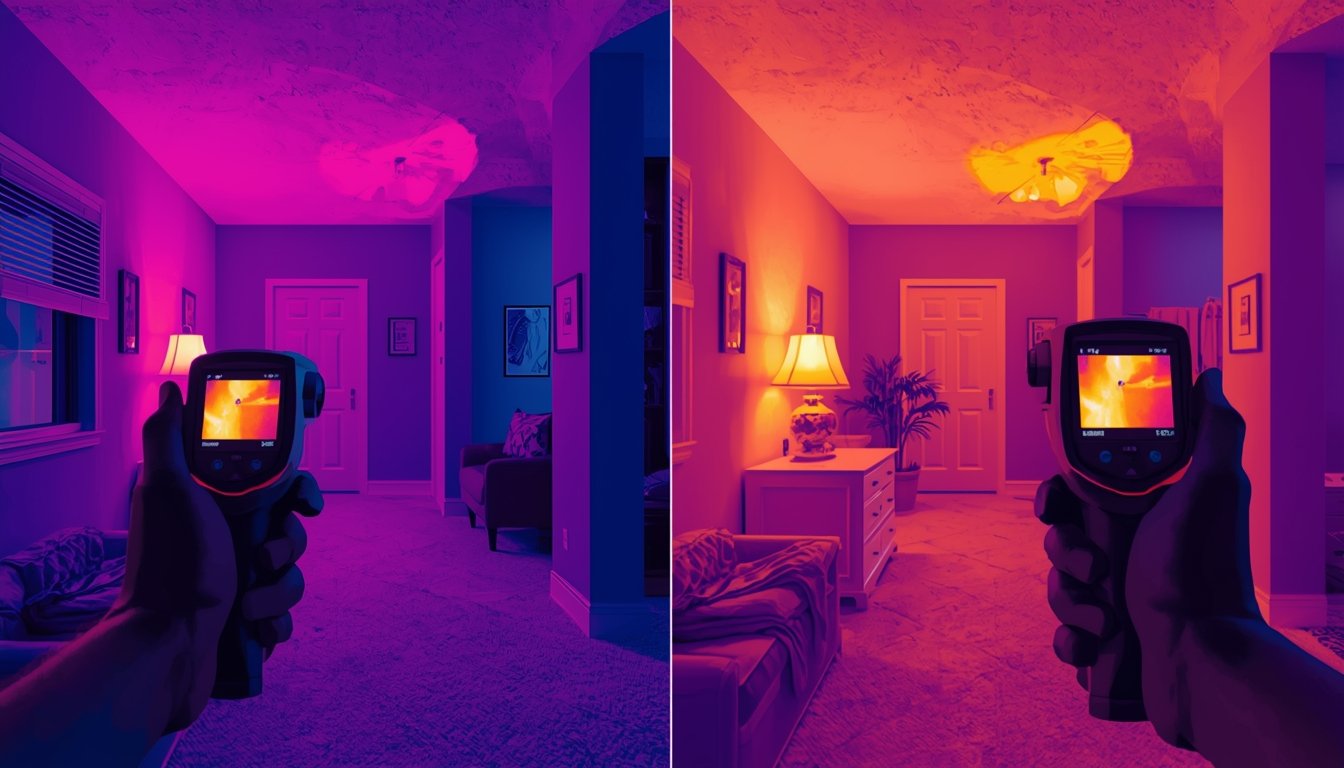
Yes, a thermal camera can help detect water leaks, but it does so indirectly by identifying temperature differences caused by moisture. It cannot see water itself, but it can highlight areas where wet materials are affecting surface temperature.
How a thermal camera helps identify water leaks
When water leaks into walls, ceilings, or floors, it changes how those materials hold and transfer heat. Wet areas often appear cooler than surrounding dry surfaces because moisture absorbs and retains temperature differently.
A thermal camera picks up these differences and displays them as visible patterns. For example, a damp section of drywall may show as a darker or cooler patch compared to the rest of the wall.
This makes it easier to narrow down the location of a potential leak without opening up surfaces. Instead of guessing where the problem is, you can scan the area and focus your inspection where temperature irregularities appear.
However, it’s important to understand that the camera is detecting the effect of moisture, not the water itself. A cool patch could indicate a leak, but it could also be caused by airflow, insulation gaps, or surface conditions. This is why thermal imaging is best used as a first step rather than a final diagnosis.
Common situations where thermal imaging finds leaks
Thermal cameras are particularly useful when a leak is hidden and not yet visible. They can help identify problem areas before major damage occurs.
Common scenarios include:
- Leaks behind walls from plumbing pipes
- Moisture spreading across ceilings from roof issues
- Slow leaks under floors or inside cavities
- Water intrusion around windows or exterior walls
For example, if you suspect a ceiling leak but cannot see staining yet, a thermal scan may reveal a cooler patch where moisture is accumulating. This gives you a clear starting point for further inspection.
They are also useful for tracking how far moisture has spread. Even if the source of the leak is small, the affected area can be larger, and thermal imaging can help map that out quickly.
To get accurate results, conditions matter. A temperature difference between wet and dry areas is needed for the camera to detect anything useful. Without that contrast, even a real leak may not show clearly.
What to check after finding a thermal anomaly
Once a thermal camera highlights a suspicious area, the next step is to confirm what is causing the temperature difference. This is where practical checks become important.
After identifying a potential leak area:
- Look for visible signs such as staining, peeling paint, or soft surfaces
- Check nearby plumbing fixtures or roof areas for obvious issues
- Use a moisture meter if available to confirm dampness
- Monitor the area over time to see if the pattern changes
These steps help confirm whether the issue is actually water-related or something else. For example, a cold patch caused by an air leak can look similar to moisture in a thermal image.
If you are unsure how to interpret the results, it helps to understand how thermal cameras detect moisture and hidden leaks in more detail before taking action.
Used correctly, a thermal camera can save time and reduce unnecessary damage by guiding you to the right area first. But it should always be combined with other checks to confirm the exact cause.