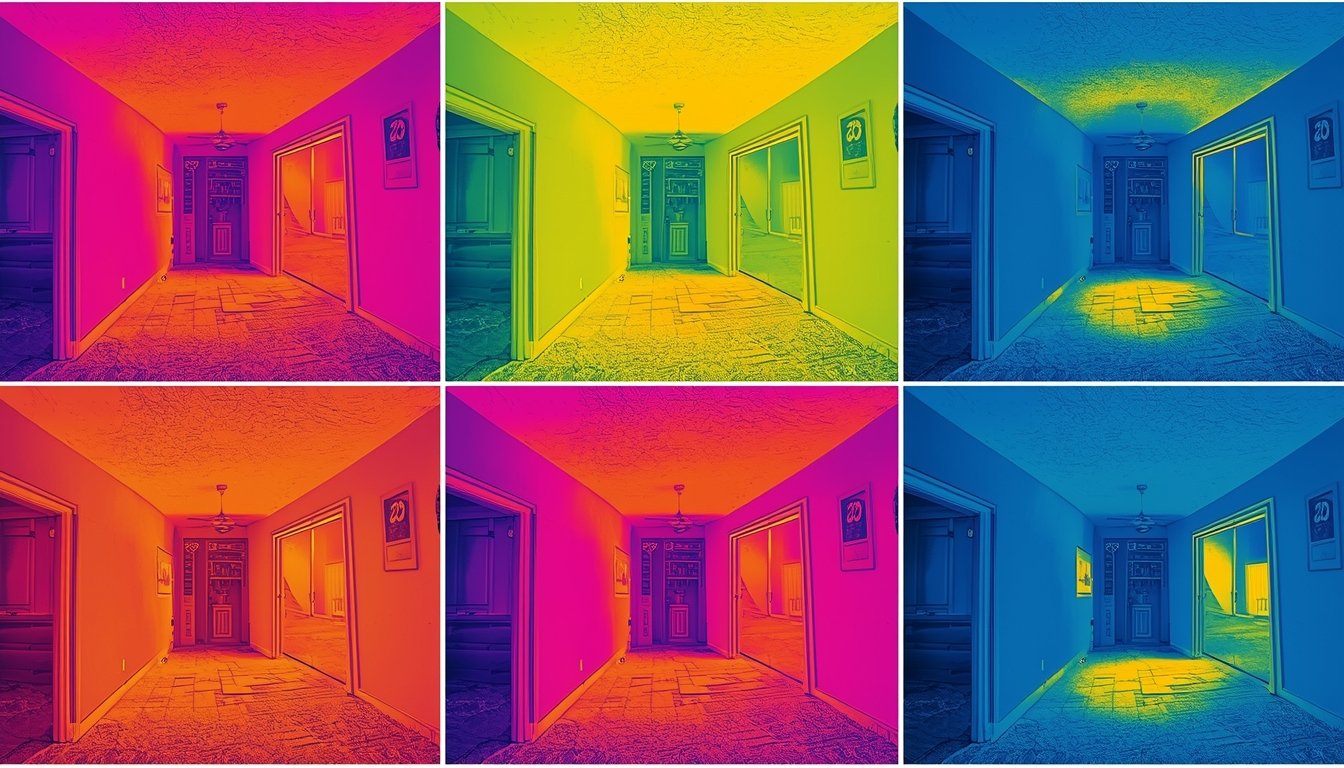
Thermal cameras can be very accurate for home use when it comes to identifying temperature differences, but their accuracy depends heavily on conditions, technique, and interpretation. They are reliable for spotting patterns like heat loss, moisture, or airflow issues, but they do not provide exact diagnoses without additional confirmation.
What “accuracy” means with a thermal camera
When people ask how accurate thermal cameras are, it’s important to understand what they are actually measuring. A thermal camera does not measure problems directly — it measures surface temperature differences. These differences are then displayed as visual patterns.
In that sense, thermal cameras are highly accurate at detecting temperature variation. If one area of a wall is cooler or warmer than another, the camera will show that clearly. This makes them very effective for identifying where something is different.
However, accuracy becomes more complex when interpreting those differences. A cold patch could indicate moisture, but it could also be caused by air movement or insulation gaps. The camera is accurate in showing the temperature change, but not in explaining the cause.
This is why understanding how a thermal camera works is essential. It helps you separate what the device is measuring from what you think it means.
In practical terms, thermal cameras are accurate tools for detection, but not for diagnosis. Their reliability comes from how they are used and interpreted.
Factors that affect thermal camera accuracy
- Temperature difference between surfaces
- Environmental conditions such as wind or sunlight
- Surface materials and reflectivity
- Camera quality and resolution
- User technique and scanning method
The biggest factor affecting accuracy is temperature contrast. Without a clear difference between surfaces, the camera will not produce useful results. Even a high-end device will struggle in low-contrast conditions.
Environmental conditions also play a major role. Direct sunlight can heat surfaces unevenly, while wind can cool them, creating patterns that do not reflect underlying issues. These external influences can reduce the reliability of the scan.
Surface materials matter as well. Reflective or glossy surfaces can distort readings by reflecting heat rather than showing actual surface temperature.
Camera quality is another factor. Higher-resolution cameras provide more detail and make it easier to identify patterns accurately. Lower-quality devices may still work, but with less precision.
Finally, user technique is critical. Moving too quickly, scanning at inconsistent distances, or focusing on isolated spots can all reduce accuracy.
How accurate thermal cameras are for common home issues
Thermal cameras are generally very reliable for identifying common home issues when used correctly. They excel at detecting patterns that indicate underlying problems.
For heat loss, they are highly effective. Insulation gaps and air leaks create clear temperature differences that are easy to spot under the right conditions. This makes thermal imaging one of the best tools for identifying energy inefficiencies.
For moisture detection, they are moderately accurate. They can highlight areas where damp materials are affecting temperature, but they cannot confirm moisture on their own. Additional tools are needed to verify the issue.
For electrical problems, they are also reliable. Overheating components create strong temperature differences that stand out clearly in a scan. This makes thermal cameras useful for identifying potential safety risks.
For airflow and HVAC issues, they provide useful insights by showing how temperature is distributed. However, interpretation is important to avoid confusing airflow patterns with other issues.
Overall, thermal cameras are accurate for identifying where a problem may exist, but not for confirming exactly what the problem is.
Limitations that reduce accuracy in real-world use
- Inability to see through walls or solid materials
- Dependence on temperature contrast
- Difficulty distinguishing between similar thermal patterns
- Influence of external conditions on readings
One of the biggest limitations is that thermal cameras only measure surface temperature. They cannot show what is inside a wall or directly identify hidden objects. This limits their ability to provide complete information.
Another limitation is the reliance on contrast. Without a temperature difference, even significant problems may not appear in the image. This can lead to false negatives.
Thermal patterns can also be similar for different issues. For example, a cold patch could indicate moisture, insulation problems, or airflow. Without additional checks, it is difficult to determine the exact cause.
External conditions can further reduce accuracy. Sunlight, wind, and recent temperature changes can all affect how surfaces appear in a thermal image.
Understanding these limitations helps you use the tool more effectively and avoid over-reliance on its results.
How to improve accuracy when using a thermal camera
Improving accuracy comes down to using the camera under the right conditions and following a consistent approach.
Start by ensuring there is a clear temperature difference between surfaces. This is the foundation of accurate thermal imaging. Without it, results will be limited.
Control environmental factors as much as possible. Avoid scanning in direct sunlight or strong airflow, and allow temperatures to stabilise before starting.
Scan methodically and compare multiple areas. Patterns that repeat or stand out are more likely to indicate real issues than isolated spots.
Use additional tools to confirm findings. A moisture meter, visual inspection, or physical checks can help verify what the thermal image suggests.
Finally, take your time. Moving slowly and maintaining a consistent distance improves the quality of the scan and makes patterns easier to interpret.
By following these steps, you can significantly improve the reliability of your results and make better decisions based on what you see.
When thermal cameras are accurate enough to rely on
Thermal cameras are accurate enough to rely on when they are used for what they are designed to do — identifying temperature differences and guiding further investigation.
They are particularly reliable when there is a clear pattern that aligns with expected behaviour. For example, consistent cold patches on exterior walls during winter strongly suggest heat loss or insulation issues.
They are also dependable when used in combination with other methods. A thermal scan that highlights a problem area, followed by confirmation through inspection or measurement, provides a high level of confidence.
However, they should not be used as the sole source of information. Relying on thermal imaging alone can lead to incorrect conclusions, especially in complex situations.
When used correctly, thermal cameras are accurate enough to be a powerful part of home inspection and maintenance. They provide valuable insights that are difficult to obtain through other methods, as long as their limitations are understood.