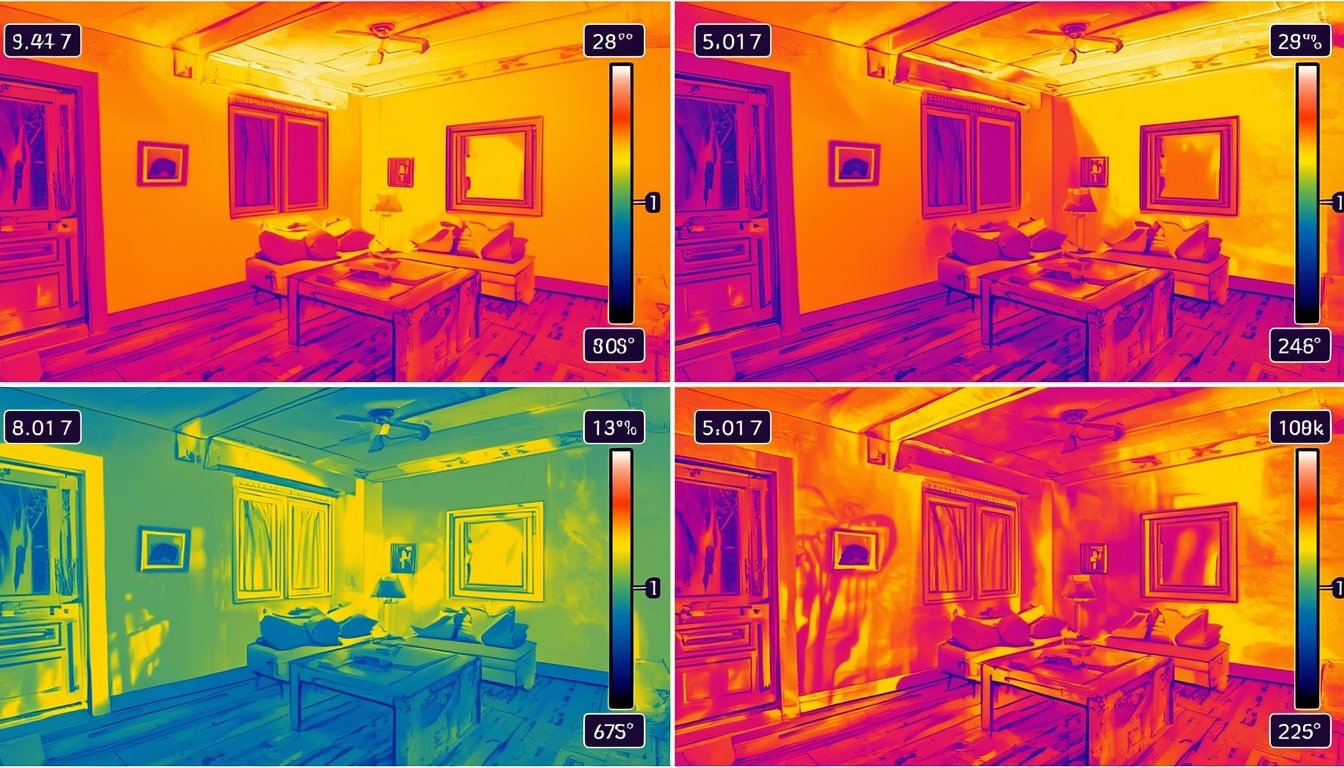
A beginner can read thermal images by understanding that they show temperature differences, not objects. Colours and patterns represent how heat is distributed across surfaces, and learning to interpret those patterns is key to identifying issues like heat loss, moisture, or airflow.
Understanding what a thermal image actually shows
A thermal image is not a photograph in the traditional sense. It does not show physical details like textures or materials. Instead, it displays infrared radiation, which represents heat emitted from surfaces.
This means that what you are seeing is a temperature map. Warmer areas appear differently from cooler ones, depending on the colour palette used by the camera. These colours are not fixed values — they are relative to the temperature range in the image.
For example, a bright area in one image may not be hotter than a darker area in another image. Each image adjusts its scale based on the temperatures being measured at that moment.
This is why context matters. You are not just looking at colours, but how those colours compare within the same image.
To interpret thermal images correctly, it helps to understand how a thermal camera works so you know what the device is actually measuring.
Once you understand that thermal images represent temperature differences rather than physical objects, it becomes easier to focus on patterns instead of expecting visual detail.
How to read colours and temperature patterns
- Warm colours (red, orange, yellow) usually indicate higher temperatures
- Cool colours (blue, purple) usually indicate lower temperatures
- Contrast between colours highlights temperature differences
- Gradual changes suggest normal variation, sharp changes suggest issues
Colours in a thermal image are used to make temperature differences easier to see, but they should not be interpreted in isolation. The most important factor is contrast within the image.
For example, a wall that appears mostly uniform with slight variation is likely behaving normally. However, a section that stands out with a noticeably different colour may indicate a problem.
Sharp edges or defined shapes often point to structural elements, such as framing or ducting. Irregular shapes are more likely to indicate issues like moisture or airflow.
It’s also important to consider the scale. Many thermal cameras allow you to adjust the colour range, which can make patterns more or less visible. A small adjustment can change how the image appears, even if the underlying temperatures remain the same.
By focusing on how colours relate to each other, rather than what they represent individually, you can interpret thermal images more accurately.
Common patterns and what they usually mean
- Cold patches on walls often indicate heat loss or insulation gaps
- Streaks or lines may suggest air leaks or airflow
- Irregular shapes can indicate moisture or dampness
- Consistent lines may follow structural elements like studs or pipes
Recognising patterns is one of the most important skills in reading thermal images. Different issues tend to create different types of patterns.
For example, insulation problems often appear as large, uneven areas where temperature differs from the rest of the wall. Air leaks, on the other hand, tend to create streaks or directional patterns.
Moisture typically appears as irregular shapes with soft edges, because it spreads through materials rather than forming defined lines.
Structural elements like framing or pipes often create consistent, repeating patterns. These are usually normal and should not be mistaken for problems.
Learning to distinguish between these patterns helps you avoid misinterpretation and focus on areas that require further investigation.
How to avoid common beginner mistakes
One of the most common mistakes is assuming that every unusual pattern indicates a problem. Some temperature variation is normal, especially around structural elements or different materials.
Another mistake is focusing on a single spot rather than looking at the overall pattern. Thermal imaging is about context, and isolated readings can be misleading.
Beginners also often overlook environmental factors. Conditions like sunlight, wind, or recent temperature changes can create patterns that are not related to underlying issues.
It is also easy to misinterpret reflective surfaces. Shiny or metallic materials can reflect heat, making them appear warmer or cooler than they actually are.
To avoid these mistakes, take a step back and look at the entire image. Compare different areas and consider how the structure and environment might be affecting what you see.
With practice, these patterns become easier to recognise, and your confidence in interpreting thermal images will improve.
How to confirm what a thermal image is showing
Reading a thermal image is only the first step. To make accurate decisions, you need to confirm what the image is suggesting.
Start by checking the same area visually. Look for signs such as stains, cracks, or gaps that might explain the temperature difference.
You can also use other tools, such as a moisture meter, to verify whether dampness is present. This helps distinguish between moisture and other causes of temperature variation.
Comparing similar areas is another useful approach. If one wall behaves differently from another under the same conditions, that difference is more likely to indicate a problem.
Monitoring changes over time can also provide insight. If a pattern appears consistently, it is more likely to represent a real issue rather than a temporary condition.
By combining thermal imaging with other checks, you can move from observation to confirmation and make more informed decisions.
How to build confidence in reading thermal images
Becoming confident in reading thermal images takes practice and a structured approach. The more you use the camera and compare results with real-world conditions, the easier it becomes to interpret patterns accurately.
Start with simple scenarios. Scan areas where you already know what to expect, such as windows, doors, or vents. This helps you understand how normal patterns appear.
Gradually move on to more complex areas, such as walls and ceilings, where multiple factors may be influencing temperature.
Take notes and compare results over time. This helps you recognise patterns and understand how different conditions affect thermal images.
Most importantly, avoid rushing. Take your time to observe patterns, compare areas, and confirm findings.
By following this approach, you can develop a clear understanding of how thermal imaging works and use it effectively for home inspection and problem-solving.