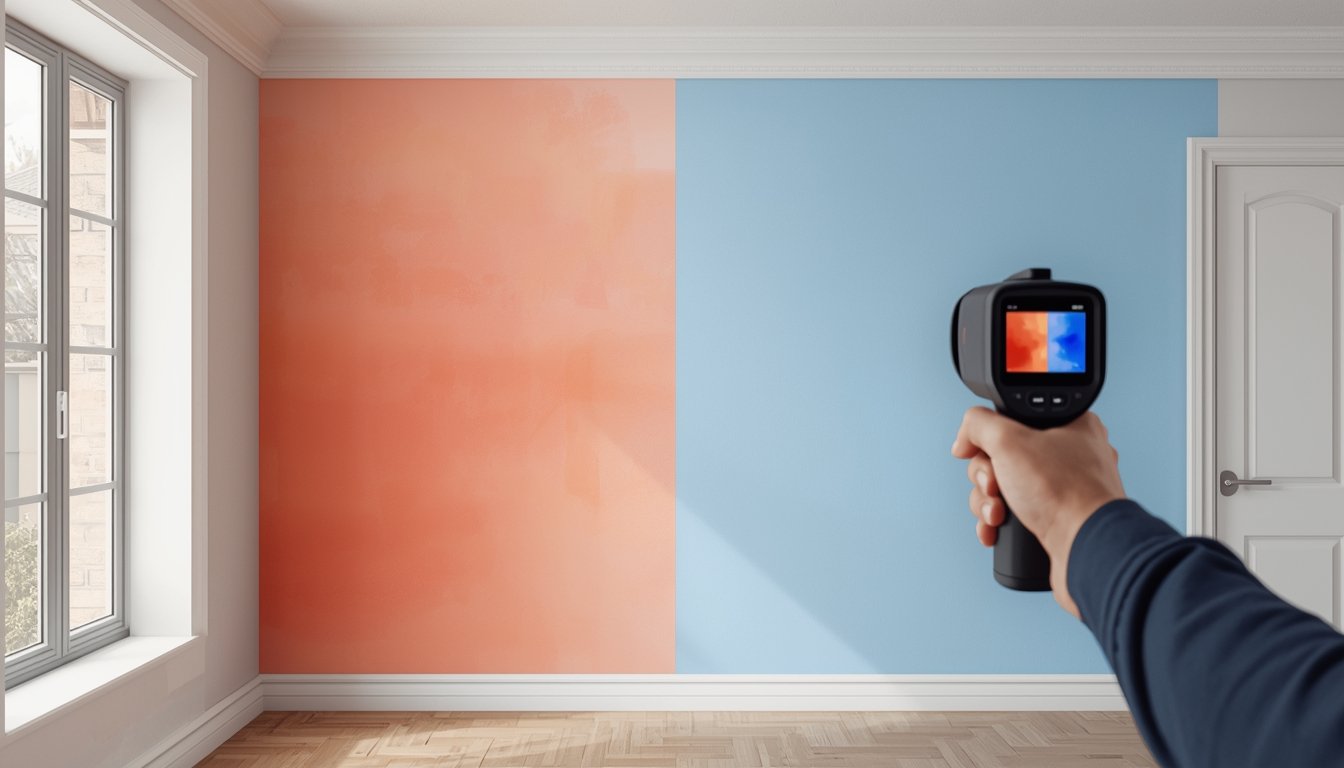
Temperature differences strongly affect thermal imaging results because a thermal camera works by comparing warmer and cooler surface areas. If there is very little temperature contrast, the image may show only weak or unclear patterns, which makes problems harder to identify.
How It Works
A thermal camera reads infrared energy from a surface and converts it into an image showing temperature variations. In a home, this allows walls, ceilings, windows, floors, and ducts to be compared based on how warm or cool they appear.
The clearer the temperature difference between one area and another, the easier it is for the image to show useful patterns. When the temperature difference is small, those patterns can become less distinct.
What It Can Do
When temperature contrast is strong enough, thermal imaging can be more useful for showing surface patterns that may need closer inspection.
- Highlight cold spots on walls and ceilings
- Show possible heat loss around windows and doors
- Help compare insulation performance between areas
- Show temperature patterns around vents, ducts, and equipment
- Make unusual warm or cool sections easier to notice
Limitations / What It Cannot Do
If the temperature difference between areas is too small, a thermal camera may not show much useful contrast. A wall with a hidden issue may look almost the same as the surrounding surface if conditions are too even.
Large temperature differences can also be misleading if they are caused by weather, sunlight, airflow, or recent heating and cooling rather than the problem being investigated. That means a strong pattern is not always proof of insulation failure, moisture, or another defect.
Thermal imaging also cannot explain the cause of a pattern by itself. A cool area may be related to moisture, air leakage, missing insulation, or simply a change in surface material. The image only shows the temperature difference, not the reason behind it.
For that reason, temperature contrast improves visibility, but it does not remove the need for careful interpretation.
When It Works Best
Thermal imaging usually works best when there is a noticeable and stable temperature difference between the surfaces being compared. This helps real patterns stand out more clearly on the image.
It is especially useful when scanning large surfaces methodically and comparing nearby areas under similar conditions. Stable indoor and outdoor conditions usually make interpretation easier than rapidly changing conditions.
Common Misconceptions
A common misconception is that a stronger temperature difference always means a more serious problem. In reality, strong differences can sometimes come from normal heating, cooling, sunlight, or airflow.
Another misconception is that weak thermal patterns mean nothing is wrong. That is also not always true, because some problems may not create enough visible contrast at the time of scanning.
Some people also assume the camera creates the temperature difference. It does not. It only displays the temperature contrast that already exists on the surface.
Final Answer Summary
Temperature differences are one of the most important factors in thermal imaging because they determine how clearly a thermal pattern appears. Stronger and more stable contrast usually makes results easier to read, but thermal images still need careful interpretation because temperature differences do not explain their own cause.