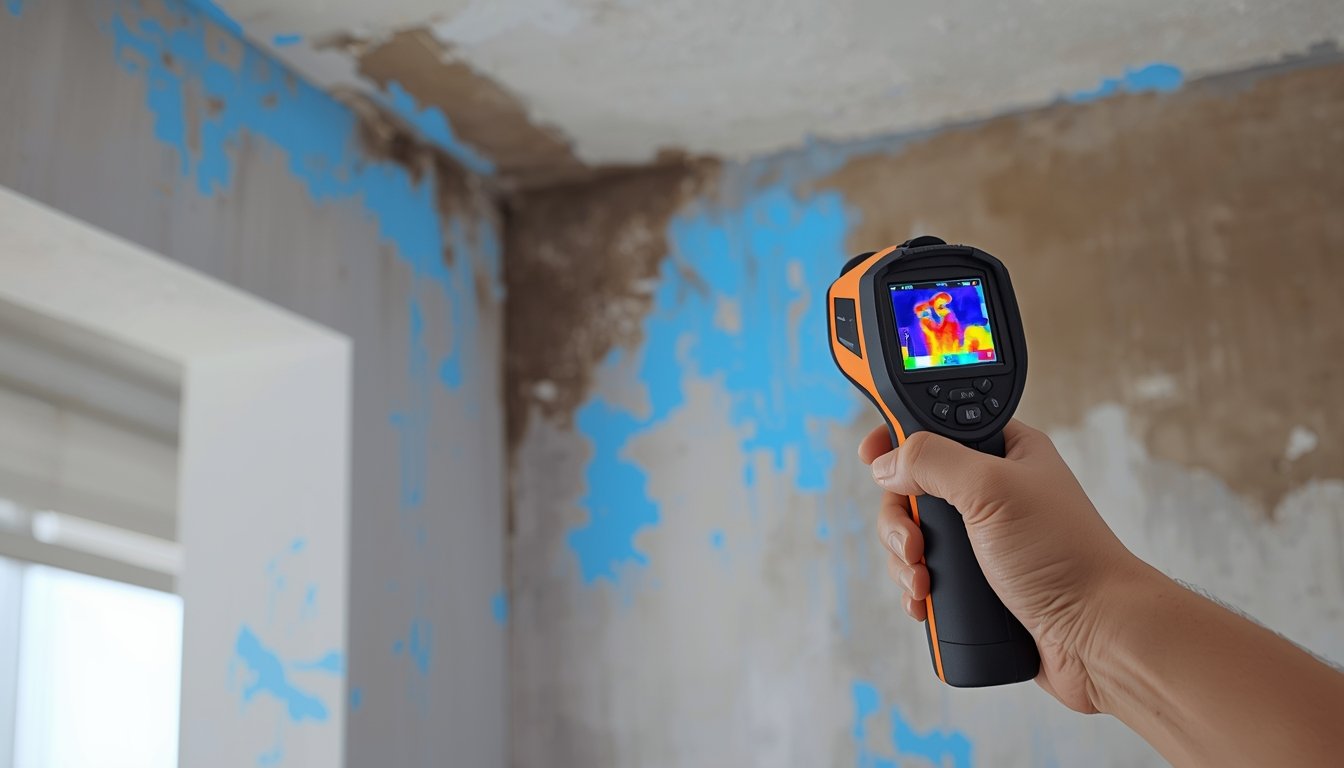
A thermal camera cannot detect mold directly. It can only show surface temperature differences that may suggest moisture patterns, and those moisture patterns can sometimes point to conditions where mold may be more likely.
How It Works
A thermal camera reads infrared energy from a surface and turns it into an image showing warmer and cooler areas. In a house, that makes it useful for comparing one part of a wall, ceiling, or floor to another.
If moisture changes the surface temperature, that difference may appear on the image. The camera is detecting the temperature pattern on the surface, not mold itself.
What It Can Do
Used correctly, a thermal camera can still help identify areas that may need closer checking.
- Show unusual cold or damp-looking temperature patterns on walls and ceilings
- Help identify suspicious areas where moisture may be present
- Highlight temperature differences around leaks, condensation, or wet materials
- Help compare nearby surfaces to find abnormal sections
- Point to areas that may need moisture testing or visual inspection
Limitations / What It Cannot Do
A thermal camera cannot confirm that mold is present. Mold itself is not something the camera sees. It only shows temperature differences on the surface being scanned.
A cool patch on a wall or ceiling may be related to moisture, but it could also be caused by missing insulation, air leakage, shade, or normal material differences. That means a thermal image alone is not enough to identify mold.
It also cannot tell what type of mold may be present, how much mold there is, or whether mold is active behind a wall. Even if moisture patterns are visible, the actual mold problem may still require visual confirmation or another type of inspection.
If the surface temperature does not differ much from the surrounding area, the camera may not show anything unusual even when moisture is present. For that reason, thermal imaging is best treated as a screening tool rather than a final answer.
When It Works Best
A thermal camera works best when moisture has created a noticeable surface temperature difference. That makes suspicious areas easier to compare against nearby dry surfaces.
It is most useful when scanning larger wall or ceiling sections methodically and comparing patterns across nearby areas. It also works better when combined with a closer visual inspection or another moisture-checking method.
Common Misconceptions
A common misconception is that a thermal camera can see mold behind walls. It cannot. It can only show temperature differences that may be related to moisture.
Another misconception is that every cool area means mold. In reality, cool spots can have several causes, and not all of them involve moisture or fungal growth.
Some people also assume that if no unusual pattern appears, there is no mold risk. That is not always true, because mold may exist without creating a strong surface temperature difference at the time of scanning.
Final Answer Summary
A thermal camera cannot detect mold directly. It can only detect temperature patterns that may suggest moisture, and those patterns may point to areas where mold could be more likely. That makes it useful for screening suspicious areas, but not for confirming mold on its own.