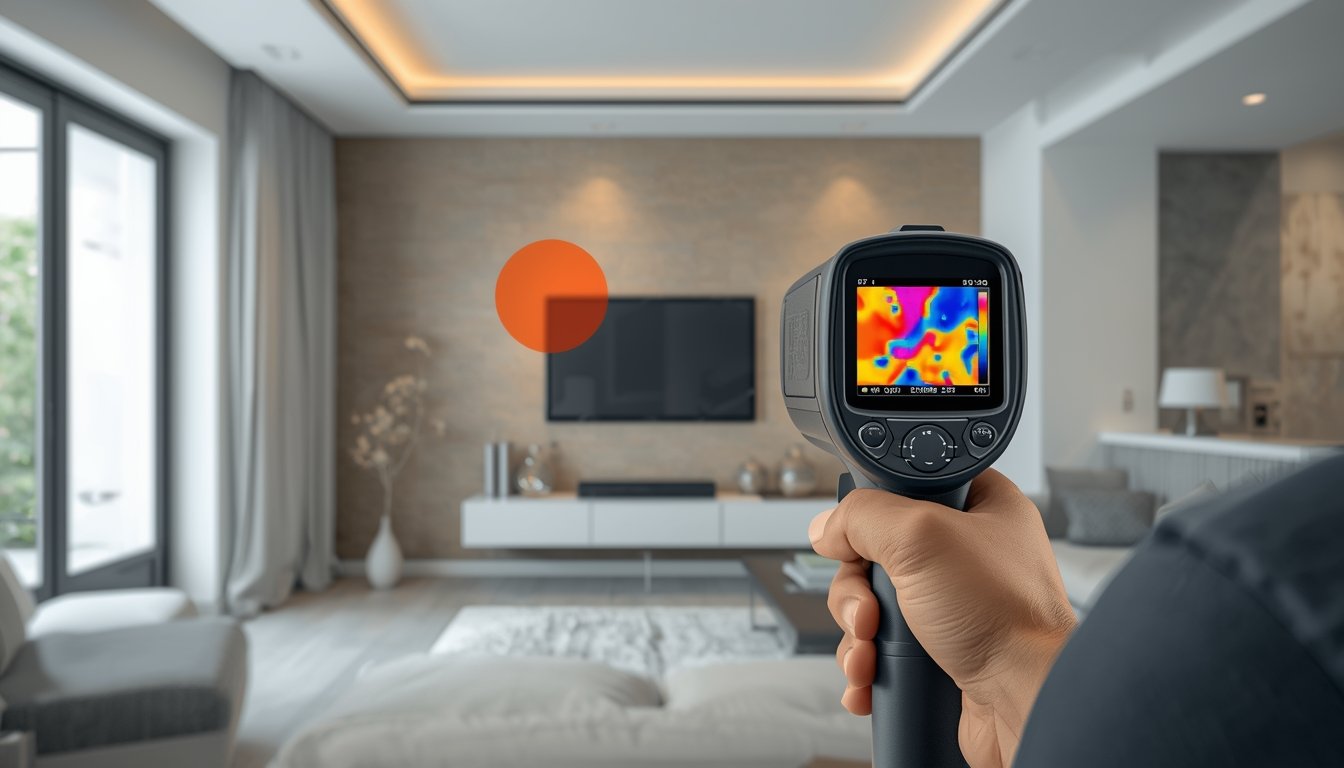
Thermal cameras can be accurate for home use when used to identify surface temperature differences, such as cold spots, heat loss, or unusual patterns in walls and ceilings. However, they are not designed to diagnose problems directly or provide perfectly precise readings in every situation.
How It Works
A thermal camera detects infrared energy emitted from surfaces and converts it into a visual image showing temperature variations. Warmer areas appear different from cooler areas, allowing users to compare sections of walls, ceilings, windows, or floors.
The camera measures surface temperature only. It does not see inside walls or directly detect hidden issues.
What It Can Do
- Identify cold spots that may indicate insulation gaps
- Highlight areas of potential heat loss around windows and doors
- Show temperature differences in walls, ceilings, and floors
- Help locate unusual hot or cold patterns around HVAC systems
- Assist in spotting areas that may need further inspection
Limitations / What It Cannot Do
Thermal cameras do not directly detect problems such as leaks, mold, or electrical faults. They only show temperature differences, and those differences can have multiple possible causes.
Accuracy can also be affected by surface materials. Shiny or reflective surfaces may distort readings, and different materials can emit heat differently, which can impact how temperatures appear on the screen.
Environmental conditions also matter. If there is little temperature difference between surfaces, the camera may not clearly show problem areas.
When It Works Best
Thermal cameras are most accurate when there is a noticeable temperature difference between areas being compared. This makes it easier to identify patterns such as heat loss or uneven insulation.
They work best when scanning large surfaces like walls and ceilings and when used consistently across multiple areas to compare results.
Common Misconceptions
Thermal cameras cannot see through walls. They only show the temperature of the surface being viewed.
They do not confirm the exact cause of a problem. A cold or hot area may have several possible explanations.
They do not always provide exact temperature readings, especially on reflective or uneven surfaces.
Final Answer Summary
Thermal cameras are accurate for identifying temperature differences in a home and are useful for spotting potential problem areas. However, they are best used as a screening tool rather than a final diagnostic solution, and their accuracy depends on conditions, materials, and correct interpretation.