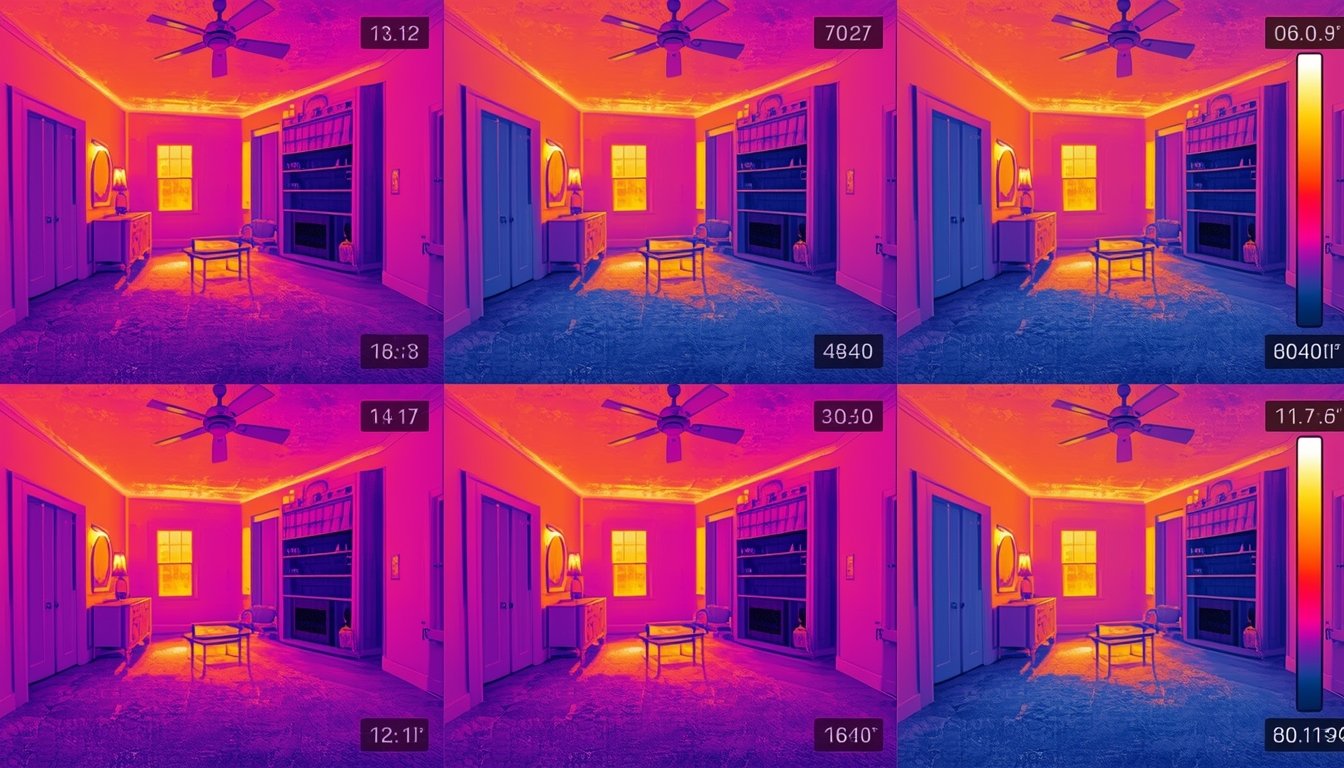
False readings in thermal imaging are usually caused by environmental conditions, reflective surfaces, poor temperature contrast, or incorrect interpretation of thermal patterns. A thermal camera is accurate at measuring surface temperature, but these factors can make the results appear misleading if not understood properly.
How environmental conditions create misleading thermal patterns
- Direct sunlight heating surfaces unevenly
- Wind or airflow cooling specific areas
- Recent heating or cooling changes affecting surfaces
- Outdoor temperature shifts influencing wall temperatures
Environmental conditions are one of the most common causes of false readings. A thermal camera shows what is happening at the surface level, and external factors can significantly influence those temperatures.
For example, a wall exposed to direct sunlight may appear warmer than surrounding areas, even if there is no issue behind it. Similarly, wind can cool certain surfaces, creating cold patches that look like insulation problems or moisture.
Rapid changes in temperature can also distort readings. If heating or cooling has just been turned on, surfaces may not have stabilised yet. This can produce temporary patterns that do not reflect actual conditions.
Outdoor temperature shifts can also affect interior readings. External walls, in particular, are influenced by outside conditions, which can create patterns that are unrelated to internal problems.
To reduce these effects, it is important to scan under stable conditions. Understanding how thermal imaging works helps you recognise when patterns are influenced by the environment rather than real issues, which is why reviewing how a thermal camera works can improve interpretation.
How surface materials and reflections distort readings
- Glossy or reflective surfaces showing reflected heat
- Metal surfaces altering temperature appearance
- Different materials retaining heat at different rates
- Surface finishes affecting how heat is emitted
Surface materials play a major role in how thermal images appear. A thermal camera measures infrared radiation emitted from surfaces, but some materials reflect heat rather than emit it clearly.
For example, a glossy surface may reflect heat from another object, making it appear warmer or cooler than it actually is. This can create patterns that do not match the real temperature of the material.
Metal surfaces are particularly challenging. They can reflect surrounding temperatures, leading to readings that are difficult to interpret accurately. This can make it appear as though there is a problem when there is none.
Different materials also retain heat differently. A wooden surface and a concrete surface exposed to the same conditions may show different temperatures, even if there is no issue. Without understanding this, it is easy to misinterpret normal variations as problems.
Recognising how materials affect thermal readings is essential for avoiding false conclusions.
Thermal cameras detect temperature differences rather than moisture directly, as explained in can a thermal camera detect water leaks directly or only temperature changes.
For suitable tools, see best thermal camera for detecting water leaks.
Why poor temperature contrast reduces accuracy
Thermal cameras rely on temperature differences to produce useful images. Without sufficient contrast, even real issues may not appear clearly, or the image may lack detail.
For example, if indoor and outdoor temperatures are similar, insulation gaps or air leaks may not create noticeable patterns. This can result in a false negative, where a problem exists but is not visible in the scan.
Low contrast can also make normal variations appear more significant than they are. When differences are small, it becomes harder to distinguish between meaningful patterns and background noise.
This is why creating the right conditions is critical. Running heating or cooling systems to establish a clear temperature difference improves the reliability of the results.
Timing also matters. Early morning or evening often provides better conditions because temperatures are more stable and less influenced by external factors.
Without proper contrast, the accuracy of thermal imaging is reduced, and the risk of false readings increases.
Misinterpreting thermal patterns and common user errors
Another major cause of false readings is misinterpretation. A thermal camera shows temperature differences, but it does not explain why those differences exist.
For example, a cold patch on a wall could indicate moisture, but it could also be caused by air movement or insulation gaps. Without additional checks, it is easy to assume the wrong cause.
User technique also plays a role. Moving the camera too quickly, scanning from inconsistent distances, or focusing on isolated spots can all reduce accuracy.
Comparing multiple areas is important. A single unusual pattern may not mean anything, but consistent patterns across similar surfaces are more likely to indicate real issues.
Understanding the context of what you are seeing is key. This includes considering the structure of the home, the materials involved, and the environmental conditions at the time of the scan.
By improving interpretation and technique, you can reduce the likelihood of false readings and make better use of the tool.
How to confirm whether a reading is accurate
Once a thermal image highlights a potential issue, the next step is to confirm whether it represents a real problem. This is essential for avoiding misdiagnosis.
Start by checking for visible signs in the same area, such as stains, gaps, or damage. These can provide clues that support or contradict the thermal pattern.
Next, use additional methods to verify the issue. For example, a moisture meter can confirm whether a cool patch is caused by dampness, while checking for drafts can help identify airflow issues.
Monitoring the area over time is also useful. If the pattern appears consistently under similar conditions, it is more likely to represent a real issue.
Comparing with other areas of the home can provide further context. If similar surfaces do not show the same pattern, the difference may indicate a problem.
Taking these steps ensures that you are not relying solely on the thermal image and helps you make more accurate decisions.
How to minimise false readings in practice
Minimising false readings comes down to preparation, technique, and understanding the limitations of the tool.
Ensure that conditions are stable and that there is sufficient temperature contrast before scanning. Avoid scanning in direct sunlight or strong airflow, as these can distort results.
Move slowly and consistently across surfaces, maintaining a steady distance. This helps produce clearer images and makes patterns easier to interpret.
Focus on patterns rather than individual spots. Consistent or repeating patterns are more reliable indicators of real issues.
Finally, always confirm findings using additional methods. A thermal camera is a powerful tool for locating problems, but it should not be the only source of information.
By following these steps, you can reduce the risk of false readings and improve the accuracy of your thermal inspections.