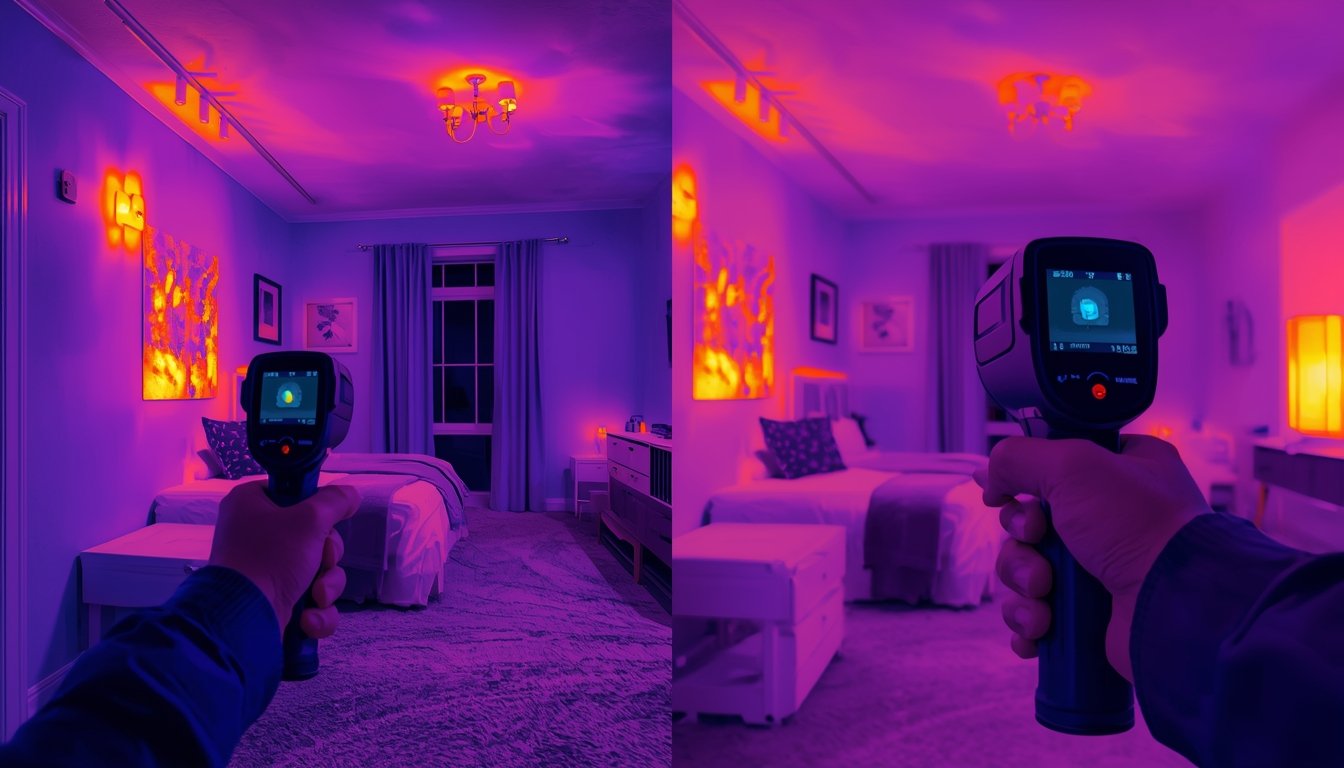
A thermal camera works by detecting infrared radiation (heat) and converting it into a visible image. It shows temperature differences across surfaces, allowing you to identify issues like heat loss, moisture, or overheating components without opening walls or causing damage.
How a thermal camera actually works
A thermal camera does not see objects in the same way your eyes do. Instead, it measures infrared energy, which is emitted by all surfaces based on their temperature. The camera then translates those temperature differences into a visual image, often using colour to represent hot and cold areas.
In a typical thermal image, warmer areas may appear as red, orange, or yellow, while cooler areas show as blue or purple. This colour contrast makes it much easier to spot irregularities that would otherwise be invisible.
The key point is that a thermal camera detects surface temperature differences, not what is inside walls or behind materials. For example, if there is a water leak behind a wall, the moisture can change the surface temperature slightly, which the camera can detect.
This is why thermal imaging is often used for diagnosing hidden issues such as insulation gaps, airflow leaks, and electrical hotspots. If you want a deeper understanding of what these tools can identify, see what a thermal camera can detect in a house.
Understanding how thermal cameras interpret temperature differences also helps explain their limitations, as outlined in what are the limitations of thermal cameras in a house.
For practical examples of how these devices are used at home, see this guide to best thermal cameras for home use.
What a thermal camera is actually used for
In a home setting, a thermal camera is mainly used as a diagnostic tool. It helps confirm whether a problem exists and where it is likely located, rather than fixing the issue itself.
Common uses include:
- Finding heat loss in walls, ceilings, and floors
- Identifying air leaks around windows and doors
- Detecting moisture behind walls or ceilings
- Checking for overheating electrical components
- Assessing HVAC performance and airflow issues
For example, if one room feels colder than the rest of the house, a thermal scan can quickly show whether the issue is poor insulation, air leakage, or uneven heating.
However, it’s important to understand that a thermal camera does not diagnose the cause with certainty. It highlights temperature differences, which then need to be interpreted correctly. A cold patch on a wall could indicate missing insulation, air movement, or even moisture — further checking is usually needed.
This is why thermal cameras are best used as part of a broader inspection process rather than as a standalone solution.
What a thermal camera cannot do
While thermal cameras are powerful tools, there are some common misunderstandings about what they can and cannot do.
They cannot:
- See through walls or solid materials
- Directly detect water, mold, or pests
- Provide exact measurements of internal conditions
- Always give accurate results without proper conditions
Instead, they rely on visible surface temperature differences. If there is no temperature variation, the camera may not reveal anything useful.
Environmental factors also play a big role. For example, using a thermal camera on a wall with no temperature contrast between inside and outside will produce very little detail. That’s why conditions like time of day, weather, and heating use can affect results.
Understanding these limitations is important. It prevents misinterpretation and helps you use the tool more effectively, especially when deciding whether a thermal camera is the right approach for a particular problem.